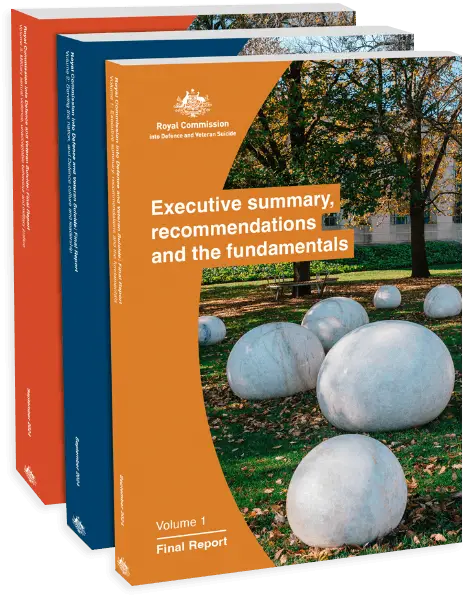
Royal Commission into Defence and Veteran Suicide (DVSRC) Recommendations in Plain Language

Historical Context
Since Federation, Australia has failed to adequately address military and veteran suicide. These deaths have been under-reported, poorly recorded, and often mishandled in public discourse.
The Call for a Royal Commission

For over 20 years, military families demanded an inquiry into defence suicides. Despite clear evidence of systemic failures, governments and defence institutions resisted action until public pressure forced change.

Notable Implementations and Updates

Defence and Veterans' Services Commission (DVSC) Independent statutory body to drive and monitor long-term reforms.

  • Acting Commissioner: Ms Penny McKay (Appointed 22 September 2025)
  • Host Department: Department of the Prime Minister and Cabinet
  • Commencement Date: 29 September 2025 (Commenced)
Legislative Process
  • Legislative Status: Standalone legislation (Defence and Veteran’s Service Commissioner Bill 2025) introduced on 27 November 2025 to formalise independence. 
New Wellbeing Architecture
  • Veterans and Families Wellbeing Agency: New agency focused on early intervention and transition support.

  • Funding: $78 million over four years (announced 2 December 2025).

  • Expected Opening: 1 July 2026.

Legislative Reform
  • VETS Act 2025: Passed (20 February 2025); consolidates three compensation schemes into one.

  • Simplified Appeals: Operational since 21 April 2025 (DRCA appeals go directly to the VRB).

  • Full Scheme Integration: New simplified compensation model takes effect: 1 July 2026.

Governance & Consultation
Whole-of-Government Approach
  • Oversight by PM&C and DVA Taskforces

Veteran-Led Design: Co-design Sessions for the Wellbeing Agency and ESO Peak Body were held (April -May 2025); feedback now informing final policy.

Color CodeStatusDescription
 
 Green
Complete
Recommendation is fully implemented, or a core deliverable has been met.
 
 Orange
Underway
Implementation is in progress, funded, or has an established delivery timeline (e.g., co-design, consultation, legislation passed).
 
 Blue
Proposed
The current state is government 'Noted' for further consideration or planning/scoping.
 
 Red
Not Started
Not yet commenced (no public action/funding/legislation).
 
 Grey
Falling Behind
The recommended timeline has been missed, or 
significant public setbacks have occurred.

Lorem ipsum dolor sit amet, consectetur adipiscing elit. Ut elit tellus, luctus nec ullamcorper mattis, pulvinar dapibus leo.

Volume 1: Recommendations and the Fundamentals

Recommendation 1

+
Recommendation 1: Improve future Royal Commissions’ operational capacity +
Status: Underway

Summary: Enhance governance and legislative frameworks to ensure future Royal Commissions can operate without obstruction, including clearer protocols for accessing protected information and structural independence for the Royal Commissions Branch.

Key Actions:

  • Separate the Royal Commissions Branch (AGD) from the Australian Government Solicitor to avoid conflicts of interest.
  • Consider relocating the Branch to PM&C or creating a dedicated Royal Commissions Office.
  • Amend legislation to guarantee timely access to public interest immunity material

Volume 2: Serving the nation, and Defence culture and leadership

Recommendations 2 to 13

+
Recommendation 3: Build the capability of career managers +
Status: Underway

Summary: Defence and DVA have established a formal data-sharing bridge. Career managers now receive “wellbeing snapshots” to help them adjust workloads or posting cycles for members showing signs of injury or health-related burnout.

Key Actions:

  • Increase the ratio of career managers to members.
  • Train career managers in trauma-informed engagement.
  • Equip them to identify and mitigate cumulative stressors (e.g., psychosocial risks) during posting decisions.
Recommendation 4: Mitigate the adverse impacts of the posting cycle +
Status: Underway

Summary: Health and rehabilitation continuity is now a mandatory “check-point” in the posting system. Members with active clinical plans cannot be posted unless the receiving location can guarantee identical levels of care and specialist access.

Key Actions:

  • Reduce relocation frequency and enhance supports (housing, childcare, spouse employment).
  • Implement a 5-year posting outlook and early rental allowance confirmations.
  • Ensure access to paid parental leave for overseas postings/deployments.
Recommendation 2: Improve outcomes and access to support for recruits in ab intro training +
Status: Underway

Summary: The $739.2 million “Early Intervention” package is now being deployed to integrate digital health screening into recruit training. This allows for real-time risk identification, ensuring that new members are connected to evidence-based care before issues escalate.

Key Actions:

  • Use mental health screening to identify and address recruits’ needs.
  • Ensure timely access to mental, physical, and spiritual health support.
  • Track long-term health outcomes and share support needs (with consent) to enable proactive assistance.
  • Provide instructors with resources and training to support vulnerable recruits.
Recommendation 5: Support all serving members to decompress, rest and reintegrate, especially after high-risk experiences +
Status: Underway

Summary: Defence has codified structured decompression periods into service doctrine. High-risk rotations now include a mandatory “reset phase” with rapid access to psychological interventions, funded under the February 2026 wellbeing initiatives.

Key Actions:

  • Develop clear post-deployment support frameworks for members and families.
  • Provide training on operational stress (e.g., grief, hypervigilance, sleep issues).
  • With consent, share deployment stressors between commanding officers.
  • Expand respite policies beyond “arduous deployments” to address fatigue.
Recommendation 6: Improve the procedural fairness of the military employment classification system +
Status: Underway

Summary: Defence will make the Military Employment Classification (MEC) system more transparent and navigable, ensuring members can advocate for themselves before employment decisions are finalised.

Key Actions:

  • Publish procedural fairness guides for decision-makers.
  • Allow members to review all relevant documents and present their case at MEC Review Boards.
Recommendation 7: Increase employment opportunities within the Australian Defence Force for members who cannot be deployed +
Status: Underway

Summary: Defence will systematically identify and create roles for members medically unfit for deployment, minimizing reliance on external contractors.

Key Actions:

  • Identify suitable non-deployable roles across the ADF.
  • Prioritise internal employment over outsourcing.
  • Monitor the relationship between deployment status and member wellbeing.
Recommendation 8: Maximise workforce retention by addressing factors that contribute to voluntary separation +
Status: Underway

Summary: Defence will implement outcomes-based retention initiatives in the 2026 Strategic Workforce Plan to address key drivers of voluntary separation.

Key Actions:

  • Analyse service-specific workforce experiences data and factors driving separation.
  • Address contributors like burnout, fatigue and stress.
  • Establish targets and performance measures to evaluate retention initiatives.
  • Expand Continuation Bonus offerings at key career decision points.
Recommendation 9: The DVSC now holds the legal power to audit unit-level wellbeing data. Public reporting on leadership performance—specifically regarding recovery results and early intervention access—is scheduled for the first DVSC Annual Report in late 2026. +
Status: Underway

Summary: Defence will develop evidence-based culture targets and annual reporting to improve leadership accountability and member wellbeing.

Key Actions:

  • Set outcomes-based targets for:
    • Psychosocial safety
    • Unacceptable behaviour reduction
    • Senior leadership accountability
  • Publish annual culture reports on service-specific progress.
  • Amend Defence Act to allow sexual harassment reporting outside chain of command.
Recommendation 10: Develop service-specific action plans to implement the Defence Respect@Work Framework +
Status: Underway

Summary: Defence will assess, and address service-specific risks related to sexual misconduct through tailored action plans.

Key Actions:

  • Assess presence of risk factors in each Service.
  • Develop Service-specific Respect@Work action plans.
  • Engage Australian Human Rights Commission for independent assessment.
Recommendation 11: Assess Australian Defence Force leaders based on upward feedback and performance against culture, health and wellbeing targets +
Status: Underway

Summary: Defence will incorporate team feedback and wellbeing metrics into leader performance reviews.

Key Actions:

  • Develop workplace behaviour reporting framework (testing in 2025)
  • Include measures of:
    • Psychological safety
    • Gender equality
    • Unacceptable behaviour management
Recommendation 12: Consider emotional intelligence and performance against wellbeing targets in selecting leaders to promote +
Status: Underway

Summary: Defence will strengthen leadership selection processes by incorporating emotional intelligence assessments and wellbeing performance metrics.

Key Actions:

  • Include performance against culture/wellbeing targets in promotion decisions.
  • Implement psychometric testing for emotional intelligence.
  • Model selection framework after UK and USA military programs.
Recommendation 13: Co-design a new doctrine recognising that operational readiness depends on a healthy workforce +
Status: Underway

Summary: Defence will develop a new ‘people, capability and service’ doctrine emphasizing workforce health as critical to operational effectiveness.

Key Actions:

  • Establish panel with diverse ex-serving members.
  • Conduct broad co-design process across ranks/services.
  • Present final doctrine by December 2026
  • Identify and address health/wellbeing barriers in policies.

Volume 3: Military sexual violence, unacceptable behaviour and military justice

Recommendations 14 to 50

+
Recommendation 14: Understand the prevalence and effects of military sexual trauma and improve responses to support victims +
Status: Underway

Summary: Government will commission independent research on military sexual trauma prevalence and impacts to inform better support systems.

Key Actions:

  • Research links between sexual misconduct and suicide risk.
  • Examine terminology impacts on victims.
  • Study needs during transition periods.
  • Identify best practice response models.
Recommendation 15: Clarify definitions and processes related to sexual offences +
Status: Underway

Summary: Defence will update policies to provide clear definitions of sexual offences and reporting procedures.

Key Actions:

  • Align definitions with Crimes Act sexual offence provisions.
  • Provide explicit instructions for consulting Military Police
  • Update Complaints and Resolutions Manual
Recommendation 16: Evaluate training on managing sexual misconduct and make it mandatory for all leaders +
Status: Underway

Summary: Defence will enhance and mandate sexual misconduct training for all commanders and managers.

Key Actions:

  • Commission independent evaluation of current training.
  • Develop improved mandatory training program.
  • Include modules on disclosure, consent and response protocols.
Recommendation 17: Prioritise the prevention of sexual misconduct in the Australian Defence Force +
Status: Underway

Summary: Defence will develop a comprehensive prevention strategy aligned with national violence prevention frameworks.

Key Actions:

  • Create sexual misconduct prevention strategy.
  • Align with National Plan to End Violence Against Women
  • Partner with Human Rights Commission and Our Watch
  • Submit strategy to Ministers for endorsement.
Recommendation 18: Strengthen workplace protections during sexual misconduct investigations +
Status: Underway

Summary: Defence will implement policies to protect victims during investigations, including separation from alleged perpetrators.

Key Actions:

  • Require immediate interim actions (work arrangement changes or paid suspension)
  • Conduct comprehensive risk assessments.
  • Regularly review interim measures until resolution
  • Allow additional protective actions as needed.
Recommendation 19: Protect victims of sexual misconduct from disadvantage over the course of their careers +
Status: Underway

Summary: Defence will prevent career penalties for victims through systemic changes to HR processes.

Key Actions:

  • Develop neutral labelling system for protective postings.
  • Report to Minister on housing/career management updates.
  • Ensure no posting with perpetrators where possible.
  • Deadline: 30 June 2025 for implementation report
Recommendation 20: Amend the legislation related to sentencing perpetrators of military sexual offences +
Status: Underway

Summary: Government will legislate to consider victim impact and rank differentials in sentencing.

Key Actions:

  • Require victim impact statements in sentencing.
  • Treat higher rank of offender as aggravating factor
  • Amend Defence Force Discipline Act 1982 accordingly.
Recommendation 21: Implement a ‘presumption’ of discharge for Australian Defence Force members found to have engaged in certain forms of sexual misconduct +
Status: Underway

Summary: Defence will establish presumption of discharge for serious sexual misconduct.

Key Actions:

  • Apply to sexual harassment, offences, image abuse, stalking.
  • Use “balance of probabilities” standard.
  • Maintain procedural fairness protections.
  • Track and report discharge statistics.
Recommendation 22: Adopt a policy of mandatory discharge for Australian Defence Force members convicted of sexual and related offences +
Status: Underway

Summary: Defence will mandate discharge for sexual offence convictions in military or civilian courts.

Key Actions:

  • Apply to all sexual and related offences.
  • Requires legislative reform.
  • Aligns with safe workplace commitments.
Recommendation 23: Record convictions of sexual offences in Australian Defence Force records and civilian criminal records +
Status: Underway

Summary: Ensure sexual offence convictions are recorded in both military and civilian systems.

Key Actions:

  • Include ADF convictions in National Police Reference System
  • Maintain complete records of civilian court convictions.
  • Coordinate with state/territory governments.
Recommendation 24: Annually publish anonymised data on outcomes of all incidents of sexual misconduct +
Status: Underway

Summary: Defence will increase transparency through regular public reporting on sexual misconduct cases.

Key Actions:

  • Publish annual service-specific data.
  • Include incident types and demographics.
  • Track administrative/disciplinary outcomes.
  • Protect victim anonymity.
Recommendation 25: Conduct a formal inquiry into military sexual violence in the Australian Defence Force +
Status: Underway

Summary: An independent external inquiry will examine the military justice system’s handling of sexual violence cases.

Key Actions:

  • Evaluate effectiveness compared to civilian justice systems.
  • Examine investigative powers and referral processes.
  • Analyse barriers to reporting and conviction rates.
  • Include victim perspectives in terms of reference.
  • Make final report publicly available.
Recommendation 26: Foster a strong culture of reporting unacceptable behaviour +
Status: Underway

Summary: Defence will enhance reporting mechanisms and transparency around behavioural risks.

Key Actions:

  • Proactively identify at-risk locations/cohorts
  • Implement targeted interventions for “hot spots”.
  • Publicly report on problem areas and actions taken
  • Integrate multiple data sources for early detection.
Recommendation 27: Evaluate outcomes to ensure that Defence has addressed the intent behind recommendations +
Status: Underway

Summary: Defence will assess implementation effectiveness of prior unacceptable behaviour recommendations.

Key Actions:

  • Evaluate Ombudsman’s 2023 review implementation.
  • Establish specialised complaints unit.
  • Ensure consistent policy application.
  • Drive continuous improvement in complaints handling.
Recommendation 28: Coordinate governance, assurance and policy functions of the military justice system +
Status: Underway

Summary: Establish new Military Justice System Assurance Branch for oversight and improvement.

Key Actions:

  • Monitor justice processes and outcomes.
  • Improve data quality and record-keeping.
  • Track implementation of review recommendations.
  • Identify misuse patterns and systemic risks.
  • Measure reform effectiveness.
Recommendation 29: Establish a new role to improve training and communication on conducting inquiries +
Status: Underway

Summary: Create Joint Workforce Capability Employment Manager position.

Key Actions:

  • Review current inquiry training approaches.
  • Develop trauma-informed practices.
  • Improve communication materials.
  • Position located in new Military Justice Assurance Branch
Recommendation 30: Prioritise the Inspector-General’s inquiry into the weaponisation of the administrative system +
Status: Underway

Summary: Inspector-General to investigate misuse of military justice administrative processes.

Key Actions:

  • Examine patterns of excessive sanctions.
  • Identify commanders with unusually high sanction rates.
  • Develop accountability measures for misuse.
  • Deadline: Commence by end of 2024
Recommendation 31: Consider how mental health may contribute to poor conduct before recommending administrative termination +
Status: Underway

Summary: Require mental health considerations in termination decisions.

Key Actions:

  • Implement November 2024 interim Directive.
  • Assess mental health factors in conduct cases.
  • Prevent inappropriate discharges due to untreated conditions.
  • Apply trauma-informed approach.
Recommendation 32: When requested, conduct a merits review when a member’s service is terminated for the reason ‘retention-not-in-service-interest’ +
Status: Underway

Summary: Establish enhanced merits review process for involuntary separations.

Key Actions:

  • Create fast-track external review option.
  • Collaborate with Inspector-General and AGD
  • Complete reviews within 60 days
  • Allow member submissions and in-person presentations.
Recommendation 33: Seek to understand whether/how involvement in military justice processes contributes to adverse outcomes +
Status: Underway

Summary: Defence will research connections between military justice involvement and negative mental health outcomes.

Key Actions:

  • Study suicide/suicidality rates among those in justice processes.
  • Examine links to substance abuse as coping mechanism.
  • Identify intervention opportunities pre-disciplinary action.
  • Build on existing health guidance for commanders.
Recommendation 34: Prioritise the review into the regulations governing court martial panels +
Status: Underway

Summary: Defence will examine requirements for court martial panels to provide punishment rationales.

Key Actions:

  • Review current regulations on panel decision-making.
  • Document findings in 2024/25 Military Justice workplan.
  • Address transparency in sentencing processes.
Recommendation 35: Determine whether support mechanisms for members involved with military justice processes are effective +
Status: Underway

Summary: Evaluate adequacy of current support systems during justice proceedings.

Key Actions:

  • Assess effectiveness of support officers/welfare boards.
  • Incorporate member experience feedback.
  • Identify gaps in legal/psychological support services.
Recommendation 36: Trial a model outside the chain of command for supporting members involved in military justice processes +
Status: Underway

Summary: Test independent support system for members in high-risk justice situations.

Key Actions:

  • Automatically connect members to external support services
  • Include Workplace Behaviour Adviser Network referrals.
  • Focus on those facing termination or serious allegations.
  • Consider role of welfare boards in new model.
Recommendation 37: Develop a charter of minimum standards for all members involved in military justice processes +
Status: Underway

Summary: Establish clear rights and expectations for justice system participants.

Key Actions:

  • Guarantee respectful treatment and clear information.
  • Require updates at key process stages.
  • Allow victim impact statements at sentencing.
  • Make charter publicly available.
  • Enable complaints if standards aren’t met.
Recommendation 38: Improve governance processes related to accountability and continuous improvement +
Status: Underway

Summary: Strengthen monitoring of mental health/wellbeing outcomes.

Key Actions:

  • Include health metrics in Budget Papers/corporate plans.
  • Develop joint Monitoring & Evaluation Framework with DVA
  • Set short/medium/long-term targets.
  • Improve performance tracking capabilities.
  • Prioritise APS Commission capability reviews.
Recommendation 39: Address risk factors for suicide and suicidality and report on progress as part of enterprise-level risk management +
Status: Underway

Summary: Integrate suicide prevention into Defence risk management systems.

Key Actions:

  • Identify in-service suicide risk factors.
  • Develop targeted control measures.
  • Report through standard risk channels.
  • Align with Mental Health & Wellbeing Strategy
  • Mental Health Branch to lead implementation.
Recommendation 40: Improve governance mechanisms from the unit level to the enterprise level +
Status: Underway

Key Actions:

  • Audit all governance reporting requirements.
  • Eliminate duplicate/unnecessary reporting.
  • Apply Lean Thinking methodologies.
  • Enhance data literacy through training.
  • Address barriers to compliance.
Recommendation 41: Build project-management capability so that reform initiatives are successful +
Status: Underway

Summary: Defence will strengthen project management capacity to ensure effective implementation of Royal Commission reforms.

Key Actions:

  • Engage independent experts to assess current project management maturity.
  • Develop improvement blueprint and implementation plan.
  • Monitor progress through Tier 1 Committee oversight
  • Focus on areas responsible for implementing recommendations.
Recommendation 42: Ensure that future Inspectors-General of the Australian Defence Force will not have served in the ADF +
Status: Underway

Summary: Future Inspectors-General will be appointed from outside the ADF to ensure independence.

Key Actions:

  • Amend Defence Act 1903 to prohibit former ADF service.
  • Appoint two qualified Deputy Inspectors-General
  • Align with recommendations from Twenty-Year Review
  • Deadline: Legislative advice by September 2025
Recommendation 43: Allow the Inspector-General of the Australian Defence Force to make recruitment decisions for the staffing of their office +
Status: Underway

Summary: The Inspector-General will have full autonomy over office staffing.

Key Actions:

  • Remove requirement for CDF/service chief input.
  • Allow hiring from ADF, APS or external candidates.
  • Ensure merit-based selection processes.
  • Finalise new staffing protocols by mid-2025.
Recommendation 44: Ensure that staff of the office of the Inspector-General of the Australian Defence Force have the necessary skills, expertise and qualifications +
Status: Underway

Summary: Implement rigorous capability assessment for Inspector-General’s office staff.

Key Actions:

  • Develop comprehensive workforce plan.
  • Conduct skills gap analysis.
  • Establish recruitment strategy for specialised roles.
  • Implement ongoing professional development.
Recommendation 45: Improve transparency and accountability of the Inspector-General of the Australian Defence Force by increasing their reporting requirements +
Status: Underway

Summary: Enhance public reporting on Inspector-General operations and performance.

Key Actions:

  • Publish detailed standard operating procedures.
  • Establish performance measures for timeliness.
  • Annual reporting against key metrics
  • Website updates by Q2 2025
Recommendation 46: Ensure staff of the Inspector-General of the Australian Defence Force are trained in trauma-informed practice +
Status: Underway

Summary: Mandate trauma training for all Inspector-General personnel.

Key Actions:

  • Require Compassionate Foundations course completion.
  • Implement biennial refresher training.
  • Include contractors and consultants.
  • Full compliance by end 2025
Recommendation 47: The Inspector-General to inquire into all deaths of serving members unless suicide can be excluded as the cause of death +
Status: Underway

Summary: Expand mandatory inquiry scope for ADF member deaths.

Key Actions:

  • Consult mental health experts in determinations.
  • Investigate service-related contributing factors.
  • Apply to all cases where suicide cannot be ruled out.
  • Implement new protocols by July 2025
Recommendation 48: When a member dies by suicide, appoint a legal officer to represent the interests of the deceased and support the next of kin +
Status: Underway

Summary: Ensure legal representation and family support in suicide inquiries.

Key Actions:

  • Assign dedicated legal officers.
  • Conduct family interviews after legal contact.
  • Develop family support protocols.
  • Implement within 6 months.
Recommendation 49: Minimise disclosure restrictions of Inspector-General inquiry reports and ensure they are fair and understood by the next of kin +
Status: Underway

Summary: Balance transparency with privacy in death inquiry reporting.

Key Actions:

  • Limit non-disclosure directions to essential sections.
  • Consult next of kin on disclosure terms.
  • Establish review mechanism for restrictions.
  • Update website guidance by Q3 2025
Recommendation 50: Amend the scope of the Inspector-General’s role to inquire into suicide deaths of former Australian Defence Force members +
Status: Underway

Summary: Extend inquiry jurisdiction to recent veterans.

Key Actions:

  • Cover deaths within 2 years of separation.
  • Apply to deaths from 30 September 2024
  • Require notification within 3 months of death.
  • Finalise legislative amendments by 2026.
Recommendation 51: The Inspector-General to regularly review inquiries into suicide deaths to determine common themes +
Status: Underway

Summary: Implement triennial analysis of suicide inquiries to identify systemic issues.

Key Actions:

  • Conduct comprehensive review every 3 years.
  • Identify patterns and contributing factors.
  • Report findings to CDF and relevant Ministers.
  • First review to be completed by Q4 2026
Recommendation 52: Conduct a merits review when a member’s service is involuntarily terminated and they submit a redress of grievance complaint +
Status: Underway

Summary: Establish robust review process for contested terminations.

Key Actions:

  • Complete reviews within 60 days of complaint
  • Allow member submissions and presentations.
  • Inspector-General to determine “correct or preferable” outcome.
  • Implement fast-track option for external reviews.
Recommendation 53: Give members 21 days to make a complaint after being notified of a decision to terminate their service +
Status: Underway

Summary: Extend complaint submission timeframe for terminated members.

Key Actions:

  • Amend policy to allow 21-day complaint window.
  • Ensure clear communication of rights.
  • Align with natural justice principles.
  • Implementation by mid-2025
Recommendation 54: Improve the frequency of military justice-related audits conducted by the Inspector-General of the Australian Defence Force +
Status: Underway

Summary: Enhance oversight through regular military justice audits.

Key Actions:

  • Audit major units every 3 years.
  • Audit training establishments every 2 years.
  • Review 3 non-major units annually
  • Publish biennial thematic analysis reports.
Recommendation 55: Conduct an audit into Defence workplace health and safety risk management +
Status: Underway

Summary: Comprehensive WHS audit focusing on psychosocial risks.

Key Actions:

  • Evaluate hazard controls and reporting accuracy.
  • Assess risk categorization methodology.
  • Include in WHS Strategy and reporting.
  • Complete audit by end 2025
Recommendation 56: Improve guidance and understanding of Defence’s ‘if in doubt, notify’ policy +
Status: Underway

Summary: Clarify incident reporting obligations to Comcare.

Key Actions:

  • Develop joint guidance with Comcare.
  • Enhance training for commanders.
  • Review notification decision processes.
  • Timeline: Ongoing through 2025
Recommendation 57: Comcare to regularly review Australian Defence Force determinations of ‘service nexus’ for suicide attempts and suspected deaths by suicide +
Status: Underway

Summary: Independent review of Defence’s service connection decisions.

Key Actions:

  • Sample review of non-notified incidents.
  • Three-year trial period
  • Defence to fund additional Comcare costs.
  • Evaluate continuation after 2027.
Recommendation 58: Give Comcare access to the National Veterans’ Data Asset +
Status: Underway

Summary: Facilitate data sharing for psychosocial harm prevention.

Key Actions:

  • Taskforce to consider access protocols.
  • Align with privacy requirements.
  • Support latent harm identification.
  • Decision pending Taskforce review
Recommendation 59: Defence to participate in Comcare’s Psychosocial Proactive Inspection Program +
Status: Underway

Summary: Voluntary engagement in workplace risk assessment program.

Key Actions:

  • Join after program refinement.
  • Fund through Defence or Commonwealth appropriation.
  • Pilot targeted Defence-specific inspections
  • Timeline: 2025-2026
Recommendation 60: Improve strategies for harm prevention and early intervention by sharing quality data with Comcare +
Status: Underway

Summary: Enhance data collaboration for suicide prevention.

Key Actions:

  • Quarterly sharing of psychosocial incident data
  • Include systemic issue analysis.
  • Document hazard mitigation actions.
  • Commence Q1 2025

Volume 4: Health care for serving and ex-serving members

Recommendations 61 to 78

+
Recommendation 61: Establish a brain injury program +
Status: Underway

Summary: Create comprehensive program to address brain injuries in military personnel.

Key Actions:

  • Monitor and assess blast overpressure exposure.
  • Record all traumatic brain injuries in medical files.
  • Develop neurocognitive symptom management program.
  • Expand non-liability mental health care coverage.
  • Taskforce to finalise implementation plan.
Recommendation 62: Establish a research translation centre for defence and veteran health care +
Status: Underway

Summary: Create dedicated centre to bridge research and clinical practice.

Key Actions:

  • Develop NHMRC-accredited research model.
  • Enhance collaboration between researchers/clinicians.
  • Focus on unique military health needs.
  • Business case under development
Recommendation 63: Reduce stigma and remove structural and cultural barriers to help seeking +
Status: Underway

Summary: Systemic changes to promote help-seeking behaviours.

Key Actions:

  • Remove “malingering” from Defence Force Discipline Act
  • Review and amend stigmatizing policies.
  • Develop anti-stigma training programs.
  • Implement by 2026
Recommendation 64: Establish an enterprise-wide program to monitor and prevent physical and psychological injury +
Status: Underway

Summary: Comprehensive injury prevention framework.

Key Actions:

  • Align with Work Health and Safety Act 2011
  • Identify common injury risks/hazards.
  • Implement prevention strategies.
  • Transparent reporting on root causes
  • Resourced with specialist staff.
Recommendation 65: Improve access to, timeliness and quality of mental health screening and use the data effectively +
Status: Underway

Summary: Enhanced mental health screening protocols.

Key Actions:

  • Screen at key career points (training, rehabilitation etc.)
  • Face-to-face screening where possible
  • Add risk factors to screening tools (anger, sleep, military sexual trauma)
  • Longitudinal data analysis
  • Qualified workforce oversight
Recommendation 66: Where possible, support injured members to be rehabilitated at work, within their home unit +
Status: Underway

Summary: Optimize return-to-work outcomes.

Key Actions:

  • Strengthen return-to-work ethos in manuals.
  • Maintain unit connections during rehab.
  • Publicly report rehabilitation outcomes
  • Resource rehabilitation services adequately
Recommendation 67: Align Defence’s clinical governance framework with the national model framework +
Status: Underway

Summary: Healthcare quality and safety improvements.

Key Actions:

  • Adopt National Model Clinical Governance Framework
  • Strengthen safety/quality monitoring.
  • Improve care coordination with DVA/civilian providers.
  • Partner with Royal College of GPs
Recommendation 68: Strike the right balance between confidentiality and information sharing for members in distress +
Status: Underway

Summary: Clarify privacy protocols for crisis situations.

Key Actions:

  • Enhance Privacy Act training.
  • Regular member understanding assessments
  • Review/update privacy policy by end 2025.
  • Consider legislative changes if needed.
Recommendation 69: Improve suicide-prevention training +
Status: Underway

Summary: More practical, trauma-informed training.

Key Actions:

  • Focus on practical intervention skills.
  • Tailor by rank/role
  • Incorporate lived experience.
  • Deliver in-person by end 2025.
  • Develop Lived Experience Framework
Recommendation 70: Revise protocols for responding to suicidal crisis +
Status: Underway

Summary: Update crisis response to clinical best practice.

Key Actions:

  • Specify culturally appropriate care standards.
  • Establish minimum aftercare requirements.
  • Develop with external experts.
  • Five-year independent evaluation
Recommendation 71: Increase the Department of Veterans’ Affairs fee schedule to align with the National Disability Insurance Scheme +
Status: Underway

Summary: Improve veteran access to healthcare through competitive provider payments.

Key Actions:

  • Benchmark DVA fees against NDIS rates.
  • Address service shortages through incentives.
  • Streamline provider payment timelines.
  • Quarterly public reporting on payment performance
Recommendation 72: Expand and strengthen healthcare services for veterans +
Status: Underway

Summary: Develop integrated veteran healthcare networks nationwide.

Key Actions:

  • Create implementation plan by September 2026
  • Increase veteran-specific hospital services.
  • Strengthen PHN partnerships.
  • Improve service navigation for veterans.
  • Address geographic service gaps.
Recommendation 73: Improve military cultural competency in health professions working with veterans +
Status: Underway

Summary: Enhance understanding of military culture among civilian providers.

Key Actions:

  • Expand Veterans Healthcare eLearning Platform.
  • Continue Military Veterans’ Psychiatry Training
  • Engage professional associations.
  • Increase Veteran Access Payments for GPs
Recommendation 74: Clarify application of Privacy Act to veterans +
Status: Underway

Summary: Review privacy provisions for veteran support.

Key Actions:

  • Obtain legal advice on information sharing.
  • Consider necessary legislative amendments.
  • Balance privacy with wellbeing support needs
  • Align with Recommendation 68 outcomes.
Recommendation 75: Conduct independent review of Open Arms +
Status: Underway

Summary: Comprehensive evaluation of veteran counselling service.

Key Actions:

  • Commission 2027 external review
  • Assess clinical standards and operations.
  • Examine service delivery model.
  • Publish findings publicly.
Recommendation 76: Develop postvention framework with experts +
Status: Underway

Summary: Structured support after suicide deaths.

Key Actions:

  • Collaborate with bereavement experts.
  • Create commander training materials.
  • Implement risk identification system.
  • Monitor wider organisational impacts.
Recommendation 77: Develop suite of postvention resources +
Status: Underway

Summary: Enhanced support for bereaved military community.

Key Actions:

  • Fund national resource network.
  • Partner with ESOs and states/territories
  • Tailor to military culture
  • Complement existing services.
Recommendation 78: Prevent, minimise and treat moral injury +
Status: Underway

Summary: Address ethical trauma in military service.

Key Actions:

  • Develop education and treatment programs.
  • Pilot Moral Injury Outcome Scale
  • Conduct Australian-specific research.
  • Include in Mental Health Strategy

Volume 5: Transition, DVA and support for ex-serving members

Recommendations 79 to 101

+
Recommendation 79: Embed respect for service throughout Defence and DVA +
Status: Underway

Summary: Cultural emphasis on service recognition.

Key Actions:

  • Identify respect improvement opportunities.
  • Conduct biennial member surveys.
  • Review Joint Transition Authority policies.
  • First survey by mid-2025
Recommendation 80: DVA to take responsibility for supporting transition out of ADF +
Status: Underway

Summary: Streamlined transition to civilian life.

Key Actions:

  • New DVA agency for transition support
  • Conduct transition readiness reviews.
  • Expand screening criteria.
  • Proactive post-separation follow-up
Recommendation 81: Fund cultural transition program for members moving to civilian life +
Status: Underway

Summary: Structured support for cultural adaptation post-service.

Key Actions:

  • Expert panel to design program (including lived experience)
  • Deliver pre- and post-separation components.
  • Focus on social connection and identity transition.
  • Three-year pilot with evaluation framework
Recommendation 82: Establish consistent policy on veterans’ base access +
Status: Underway

Summary: Balance security needs with veteran community connections.

Key Actions:

  • Standardised national access framework.
  • Local commander discretion for approvals
  • Priority access first year post-separation
  • Policy review completed by Q3 2025
Recommendation 83: Increase civilian qualification opportunities from military training +
Status: Underway

Summary: Maximise recognition of military skills.

Key Actions:

  • Issue qualifications upon course completion (from 1/7/25)
  • Remove qualification caps.
  • Explore bridging course options (not yet committed)
  • Map all training to national standards.
Recommendation 84: Provide separating members with detailed skills references +
Status: Underway

Summary: Enhance veteran employment prospects.

Key Actions:

  • Standardised skills certification
  • Include commanding officer contacts.
  • Service-wide implementation.
  • Digital and hardcopy formats
Recommendation 85: Develop public sector employment pathways for veterans +
Status: Underway

Summary: Leverage military skills in government roles.

Key Actions:

  • Expand VetPaths program.
  • Target health, justice and emergency sectors
  • APS Commission coordination
  • State/territory government engagement.
Recommendation 86: Secure ongoing funding for Veterans’ Hubs +
Status: Underway

Summary: Sustainable operation of community support hubs.

Key Actions:

  • Develop long-term funding model.
  • Differentiate operational vs service funding.
  • Standardized data collection
  • Partner with state governments
Recommendation 87: Establish new veteran wellbeing agency within DVA +
Status: Underway

Summary: A dedicated agency focused on early intervention and seamless transition support, moving away from the currently fragmented system.

Key Actions:

  • $78 million over four years officially allocated (announced Dec 2025).
  • Scheduled to open 1 July 2026 within the Department of Veterans’ Affairs..
  • Will consolidate transition services currently split between Defence and DVA.
Recommendation 88: Develop National Funding Agreement on veterans’ wellbeing +
Status: Underway

Summary: Cross-jurisdictional approach to veteran support.

Key Actions:

  • Priority focus areas:
    • Veteran homelessness
    • Incarcerated veterans
    • Healthcare networks
  • Data sharing agreements
Recommendation 89: Establish national peak body for ex-service organisations +
Status: Underway

Summary: Unified voice for veteran advocacy groups.

Key Actions:

  • National roadshow complete; feedback from 600+ participants is shaping the final governance.
  • 1 Feb 2026 new Institute of Veterans’ Advocacy (IVA) to professionalise the sector.
  • Model being designed specifically to ensure smaller ESOs are not overshadowed by larger organizations.
  • IVA Accepting membership applications since 1 Feb 2026
Recommendation 90: Remove service differential for impairment compensation +
Status: Underway

Summary: Government maintains different compensation rates.

Key Actions:

  • No change to operational/non-operational distinctions
  • Expand non-liability mental health care to all reservists.
  • Review reserve mental health access.
Recommendation 91: Implement combined benefits processing for claims +
Status: Underway

Summary: Streamline DVA claims processing through integrated assessment.

Key Actions:

  • VETS Act 2025 Passed Parliament (Feb 2025).
  • All existing payments are “locked in” and won’t be reduced.
  • New Benefits Introduced the Additional Disablement Amount (ADA) for older veterans.
  • Align with new single Act provisions.
Recommendation 92: Review historical claims related to physical/sexual abuse +
Status: Underway

Summary: Independent examination of abuse claim handling.

Key Actions:

  • Analyse 2015-2024 claim decisions
  • Assess trauma-informed practice.
  • Review victim support provisions.
  • Final report with improvement recommendations
Recommendation 93: Fund Transition Medical Assessment Pilot nationally +
Status: Underway

Summary: Expand medical transition support program.

Key Actions:

  • North Queensland expansion 2025-26
  • National rollout from 2026-27
  • Focus on complex-needs members.
  • Pending pilot evaluation results
Recommendation 94: Improve Defence-DVA information sharing for claims +
Status: Complete

Summary: Faster, more transparent claims processing.

Key Actions:

  • Set/report on SAM transfer time targets.
  • Annual digital record progress reports
  • Health Knowledge Management System integration
  • Quarterly performance updates
Recommendation 95: Support expanded ‘presumptive liability’ application +
Status: Underway

Summary: Simplify claims for certain service-related conditions.

Key Actions:

  • Establish permanent research team.
  • Monitor civilian compensation schemes.
  • Immediate focus on PTSD presumption
  • Since 21 April 2025 all appeals now go straight to the Veterans’ Review Board
Recommendation 96: Continue Provisional Access to Medical Treatment +
Status: Underway

Summary: Maintain interim healthcare access.

Key Actions:

  • Extend funding beyond June 2026
  • Cover treatment until 31/12/2026.
  • For claims under determination
  • Common conditions coverage
Recommendation 97: Consider Veteran Payment for physical health conditions +
Status: Underway

Summary: Financial support expansion study.

Key Actions:

  • Research suicide risk in physical conditions.
  • Repatriation Commission review
  • Current mental health requirement maintained.
  • Report to Government
Recommendation 98: Strengthen DVA claims processing targets +
Status: Underway

Summary: Ambitious but achievable performance standards.

Key Actions:

  • 65% within 90 days by 7/2026
  • 80% within 90 days by 7/2028
  • Publish examination usage data.
  • Quarterly public reporting
Recommendation 99: Fund professional compensation advocates +
Status: Underway

Summary: Replace grant system with sustainable model.

Key Actions:

  • Minimum 3-year funding terms
  • Demand-driven allocation.
  • Equity for women/LGBTIQ+ veterans
  • WA pilot program evaluation
Recommendation 100: Enhance DVA rehabilitation program transparency +
Status: Underway

Summary: Clearer outcomes measurement and reporting.

Key Actions:

  • 75% goal achievement target
  • Provider performance breakdowns
  • Client access to provider data
  • Annual public reporting
Recommendation 101: Increase veteran choice in care management +
Status: Underway

Summary: NDIS-style autonomy where appropriate.

Key Actions:

  • Provider selection flexibility
  • Self-managed household budgets
  • Travel cost reimbursements.
  • Legislative amendments progressing

Volume 6: Families, data and research, and establishing a new entity

Recommendations 102 to 122

+
Recommendation 102: Implement Defence Family Violence Strategy +
Status: Underway

Summary: Comprehensive approach to prevention.

Key Actions:

  • Link to suicide prevention
  • Full DFA recommendation implementation
  • Base access protocols for emergency services
  • Action Plan by end 2024
Recommendation 103: Enhance support for Defence families +
Status: Underway

Summary: Whole-of-family wellbeing approach.

Key Actions:

  • Co-designed support programs
  • Improved DMFS communication
  • Increased family therapy access
  • Public evaluation framework
Recommendation 104: Strengthen Defence Family Advocate role +
Status: Underway

Summary: Boost resources for family representation.

Key Actions:

  • Adequate staffing/budget
  • Formal Veteran Family Advocate links
  • Implement past review recommendations.
  • Shared services exploration
Recommendation 105: Improve engagement with coronial system +
Status: Underway

Summary: By late 2026, better coordination on suicide data.

Key Actions:

  • Align jurisdictional practices.
  • Trauma-informed information sharing
  • AGD-led state/territory discussions.
  • NCIS utilisation review
Recommendation 106: Establish dedicated suicide database +
Status: Underway

Summary: Comprehensive tracking of service impacts.

Key Actions:

  • Lifetime service coverage
  • Risk/protective factor inclusion.
  • AIHW collaboration
  • Five Eyes best practice
Recommendation 107: Develop National Veterans’ Data Asset +
Status: Underway

Summary: Integrated data for suicide prevention.

Key Actions:

  • Veteran screening questions agreed upon
  • Privacy-protected framework
  • Multi-agency collaboration
  • Phased implementation.
Recommendation 108: Ensure jurisdictional data contributions +
Status: Underway

Summary: Whole-of-government approach.

Key Actions:

  • Priority for Defence/DVA
  • State/territory agreements.
  • Standardized data protocols
  • Ongoing Taskforce review
Recommendation 109: Annual Defence data improvement reporting +
Status: Underway

Summary: Measurable progress on information management.

Key Actions:

  • Ministerial annual updates
  • APS Data Maturity Framework
  • Enterprise-wide benchmarks
  • First report 2025
Recommendation 110: Review Defence data assets +
Status: Underway

Summary: Comprehensive quality assessment.

Key Actions:

  • Quality/management audit
  • ERP program alignment
  • Integration opportunities
  • Taskforce consideration
Recommendation 111: Achieve ‘gold standard’ for suicide-related data +
Status: Underway

Summary: Highest quality data practices.

Key Actions:

  • Tiered improvement targets
  • Specialized dataset management
  • Cross-functional coordination
  • Resourcing assessment
Recommendation 112: Include suicide data in Defence catalogue +
Status: Underway

Summary: Centralized accessibility.

Key Actions:

  • Priority Data Strategy 2.0 action
  • Metadata standards compliance
  • Secure access protocols
  • Q4 2025 completion
Recommendation 113: Commanding officer access to wellbeing data +
Status: Underway

Summary: Data-driven decision making.

Key Actions:

  • Privacy-compliant access
  • Suicide database integration.
  • Behavioural trend analysis
  • Taskforce review
Recommendation 114: Prioritize veteran health research +
Status: Underway

Summary: Evidence-based policy foundation.

Key Actions:

  • Monash University literature review
  • Publish research workplans.
  • VF-LINK partnership
  • Annual reporting
Recommendation 115: Publish Defence/DVA health research +
Status: Underway

Summary: Transparent knowledge sharing.

Key Actions:

  • Independent peer review
  • Expert committee oversight
  • Annual publication cycle
  • Research gap analysis.
Recommendation 116: Improve research quality and translation +
Status: Underway

Summary: Bridge research-practice gap.

Key Actions:

  • Central evaluation teams
  • Evidence library creation
  • Policy integration protocols
  • Joint research agenda
Recommendation 117: Establish expert veteran research committee +
Status: Underway

Summary: High-level strategic guidance.

Key Actions:

  • Multidisciplinary membership
  • Lived experience inclusion.
  • Five Eyes knowledge exchange
  • Annual workplan
Recommendation 118: Retain Census ADF service question +
Status: Underway

Summary: Maintain veteran population data.

Key Actions:

  • 2026 Census inclusion
  • Advocate for separation year question
  • Alternative data source review
  • ABS collaboration
Recommendation 119: Add veteran questions to ABS surveys +
Status: Underway

Summary: Enhanced health understanding.

Key Actions:

  • National Health Study inclusion
  • Increased veteran sample sizes.
  • DHAC/NHMRC coordination
  • Funding dependent
Recommendation 120: Increase veteran health research funding +
Status: Underway

Summary: Targeted investment.

Key Actions:

  • $10M NHMRC special initiative
  • MRFF alignment
  • Million Minds Mission
  • Taskforce options
Recommendation 121: Enable research on Defence families +
Status: Underway

Summary: Whole-family wellbeing focus.

Key Actions:

  • AIHW/ABS/AIFS collaboration
  • Existing data utilization
  • Lived experience partnership.
  • Taskforce coordination
Recommendation 122: Establish a statutory oversight entity for veteran suicide prevention +
Status: Falling Behind

Summary: Create an independent statutory body to monitor and drive implementation of the Royal Commission’s reforms, ensuring evidence-based improvements to suicide prevention and wellbeing for serving and ex-serving ADF members.

Key Actions:

  • Currently led by Acting Commissioner Ms Penny McKay while a permanent inaugural Commissioner is recruited.
  • Operations offically began 29 September 2025
  • $44.5 million over four years allocated for operational independence.
  • Deliver evidence-based advice on system improvements

Progress Update:

  • Interim head already appointed
  • Standalone legislation (the Defence and Veterans’ Service Commissioner Bill 2025) 27 November 2025 to move the body out of the Defence Act.
  • Granted “Special Inquiry” powers, such as compelling evidence and documents from Commonwealth entities.

Establishment of the Royal Commission

On 8 July 2021, Governor-General David Hurley formally established the RCDVS to investigate:

  • Systemic risk factors for suicide in defence communities
  • Cultural and institutional failures in the ADF and DVA
  • Barriers to effective support for serving and ex-serving personnel.

The Commission was led by Nick Kaldas APM, Hon James Douglas KC, and Dr Peggy Brown AO.


Over three years, the Commission:

  • Held 12 public hearings (100+ days) with 340+ witnesses.
  • Conducted 897 private sessions with affected individuals.
  • Received 5,865 submissions from ADF members, veterans, families, and organisations.


The Australian Government supported the inquiry by:

  • Responding to 1,220 notices for evidence (producing 256,761 documents)
  • Facilitating 206 witness appearances and 27 Defence base visits


The final report exposed: deep cultural problems in Defence and administrative failures in veterans’ support. The government pledged “real, meaningful, and enduring reform”, leading to the recommendations summarised in this document.


This Document: Tracks progress through the Open-Door Report Card, translating 122 recommendations into clear, actionable summaries.

Notable Implementations and Updates

Defence and Veterans’ Services Commission (DVSC) Independent statutory body to drive and monitor long-term reforms.

  • Interim Head: Mr Michael Manthorpe PSM (leading establishment)
  • Host Department: Department of the Prime Minister and Cabinet
  • Commencement Date: 29 September 2025


Legislative Process

  • Under review by Senate Foreign Affairs, Defence and Trade Legislation Committee
  • Reporting Deadline: 29 August 2025


Veterans’ Entitlements Reform: Key Legislation

VETS Act 2025Consolidates three legacy compensation schemes into one simplified system.

  1. Passed Parliament: 13 February 2025
  2. Received Royal Assent: 20 February 2025


System Improvements

Simplified Appeals (Operational since 21 April 2025):

  • Veterans now lodge DRCA appeals directly with the Veterans’ Review Board

Full Scheme Integration:

  • New compensation model takes effect: 1 July 2026


Governance & Consultation

Whole-of-Government Approach

  • PM&C Taskforce: Overseeing cross-agency implementation.
  • DVA Taskforce: Led by Deputy Secretary Teena Blewitt


Veteran-Led Design: Co-design Sessions form April-May 2025 with ex-service organisations (ESOs) and public consultation. Submissions closed on the 15 May 2025. Feedback is now used to inform final policy settings.

Volume 1: Recommendations and the Fundamentals

Recommendation 1

Status: Noted

Summary: Enhance governance and legislative frameworks to ensure future Royal Commissions can operate without obstruction, including clearer protocols for accessing protected information and structural independence for the Royal Commissions Branch.

Key Actions:

  • Separate the Royal Commissions Branch (AGD) from the Australian Government Solicitor to avoid conflicts of interest
  • Consider relocating the Branch to PM&C or creating a dedicated Royal Commissions Office
  • Amend legislation to guarantee timely access to public interest immunity material
  • AGD to provide guidance on balancing Parliamentary privilege, procedural fairness, and investigative efficacy

Volume 2: Serving the nation, and Defence culture and leadership

Recommendations 2 - 13

Status: Agreed

Summary: Defence will enhance support for recruits during initial training by developing a resilience-focused model, reducing barriers to care, and ensuring instructors are equipped to lead vulnerable individuals.

Key Actions:

  • Use mental health screening to identify and address recruits’ needs.
  • Ensure timely access to mental, physical, and spiritual health support.
  • Track long-term health outcomes and share support needs (with consent) to enable proactive assistance.
  • Provide instructors with resources and training to support vulnerable recruits.

Status: Agreed

Summary: Defence will strengthen career managers’ ability to support ADF members through trauma-informed practices and improved HR systems.

Key Actions:

  • Increase the ratio of career managers to members.
  • Train career managers in trauma-informed engagement.
  • Equip them to identify and mitigate cumulative stressors (e.g., psychosocial risks) during posting decisions.

Status: Agreed

Summary: Defence will reduce relocation burdens on members and families by trialling support measures and improving planning tools.

Key Actions:

  • Reduce relocation frequency and enhance supports (housing, childcare, spouse employment).
  • Implement a 5-year posting outlook and early rental allowance confirmations.
  • Ensure access to paid parental leave for overseas postings/deployments.

Status: Agreed

Summary: Defence will implement a structured framework for post-deployment psychosocial support and respite, ensuring evidence-based approaches to decompression and reintegration.

Key Actions:

  • Develop clear post-deployment support frameworks for members and families.
  • Provide training on operational stress (e.g., grief, hypervigilance, sleep issues).
  • With consent, share deployment stressors between commanding officers.
  • Expand respite policies beyond “arduous deployments” to address fatigue.

Status: Agreed

Summary: Defence will make the Military Employment Classification (MEC) system more transparent and navigable, ensuring members can advocate for themselves before employment decisions are finalised.

Key Actions:

  • Publish procedural fairness guides for decision-makers.
  • Allow members to review all relevant documents and present their case at MEC Review Boards.

Status: Agreed

Summary: Defence will systematically identify and create roles for members medically unfit for deployment, minimizing reliance on external contractors.

Key Actions:

  • Identify suitable non-deployable roles across the ADF.
  • Prioritise internal employment over outsourcing.
  • Monitor the relationship between deployment status and member wellbeing.

Status: Agreed

Summary: Defence will implement outcomes-based retention initiatives in the 2026 Strategic Workforce Plan to address key drivers of voluntary separation.

Key Actions:

  • Analyse service-specific workforce experiences data and factors driving separation.
  • Address contributors like burnout, fatigue and stress.
  • Establish targets and performance measures to evaluate retention initiatives.
  • Expand Continuation Bonus offerings at key career decision points.

Status: Agreed

Summary: Defence will develop evidence-based culture targets and annual reporting to improve leadership accountability and member wellbeing.

Key Actions:

  • Set outcomes-based targets for:
    • Psychosocial safety
    • Unacceptable behaviour reduction
    • Senior leadership accountability
  • Publish annual culture reports on service-specific progress.
  • Amend Defence Act to allow sexual harassment reporting outside chain of command.

Status: Agreed-in-principle.

Summary: Defence will assess, and address service-specific risks related to sexual misconduct through tailored action plans.

Key Actions:

  • Assess presence of risk factors in each Service.
  • Develop Service-specific Respect@Work action plans.
  • Engage Australian Human Rights Commission for independent assessment.

Status: Agreed

Summary: Defence will incorporate team feedback and wellbeing metrics into leader performance reviews.

Key Actions:

  • Develop workplace behaviour reporting framework (testing in 2025)
  • Include measures of:
    • Psychological safety
    • Gender equality
    • Unacceptable behaviour management

Status: Agreed

Summary: Defence will strengthen leadership selection processes by incorporating emotional intelligence assessments and wellbeing performance metrics.

Key Actions:

  • Include performance against culture/wellbeing targets in promotion decisions.
  • Implement psychometric testing for emotional intelligence.
  • Model selection framework after UK and USA military programs.

Status: Agreed

Summary: Defence will develop a new ‘people, capability and service’ doctrine emphasizing workforce health as critical to operational effectiveness.

Key Actions:

  • Establish panel with diverse ex-serving members.
  • Conduct broad co-design process across ranks/services.
  • Present final doctrine by December 2026
  • Identify and address health/wellbeing barriers in policies.